
Provide Affordable Housing for Canadians
CV21 supports the goal of making decent affordable homes available for the bottom 40% of income earners.
For the past 30 years, Canada’s virtually single-minded focus on market-housing and real estate as a speculative investment play, have stranded millions of Canadians on the outside looking in. House prices took off markedly after 2008 in many of Canada’s metropolitan areas, as a combination of low interest lending rates, FOMO-driven purchasers, and federal policies which made mortgage lending virtually risk free for banks, drove speculation and house price inflation. Under various governments the housing market has essentially been de-coupled from the labor market. It is time to reverse this trend.
The problem
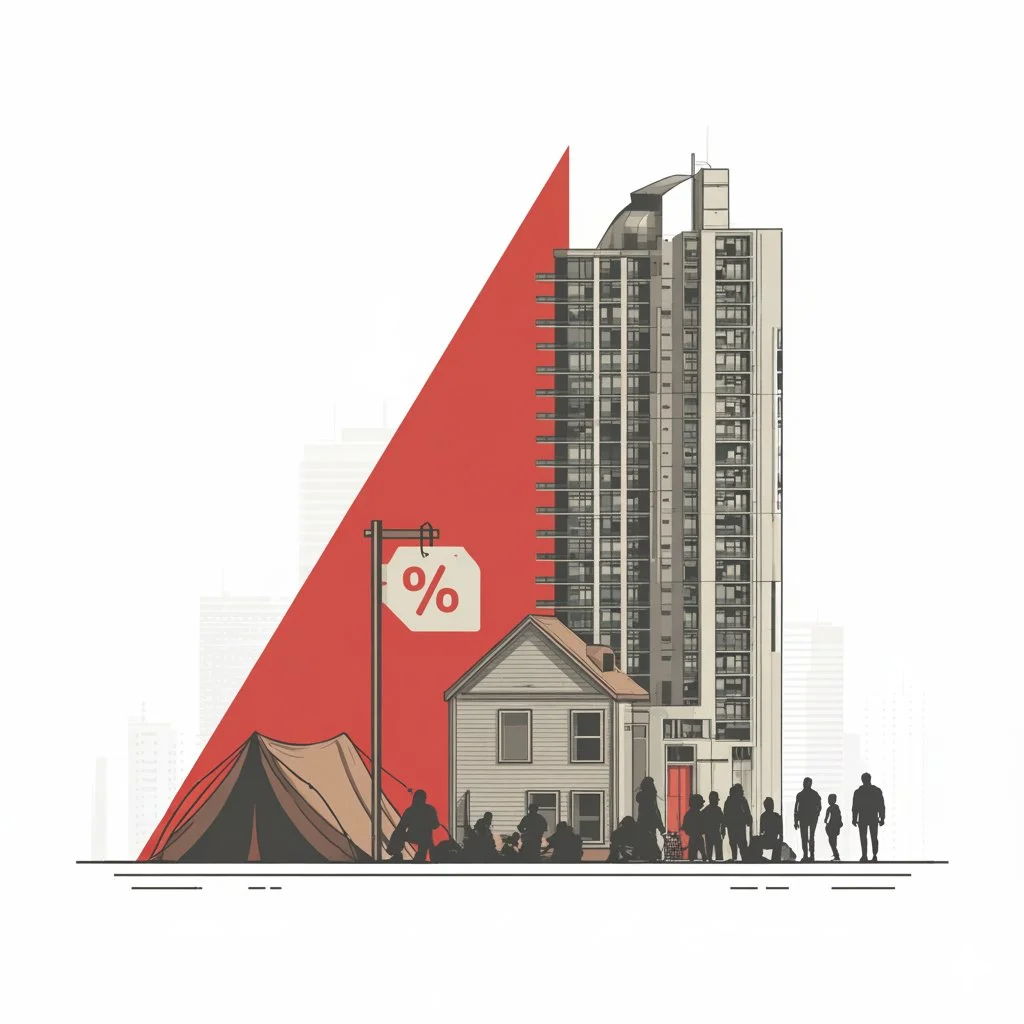
The hallmark of a civilized society is that it provides adequate shelter to all who need it. Shelter is part of Maslow’s ‘hierarchy of needs.’ In theory, everyone in Canada is equally entitled to access housing that meets basic conditions. These conditions require housing to be secure, affordable, habitable, accessible and culturally appropriate, while being in a location that is safe and allows engagement with local economies and services. The reality today in Canada, is strikingly at odds with this policy intent. The problems in Canada’s housing sector are many. For starters, Canada’s most vulnerable populations are ill-housed: Indigenous peoples; persons with a physical, cognitive or mental disability; low and moderate income folks; the young; single parent families; women fleeing violence, seniors on modest fixed incomes etc. There are currently 1.5 million households living in ‘core housing need’ [2021 Census data]. Between 1994 and 2017, fewer than 4,000 nonmarket homes were built every year in contrast to the 1970s and early 1980s, when 35,00 to 40,000 nonmarket homes were built per year. In terms of purpose built rental stock, including larger apartments, traditionally the leading source of affordable housing, it too has been radically cut back. In the two decades between 1960 and 1980, about 50,000 apartments were built each year. In the four decades between 1980 and 2022, half that number were built. Effectively, starting with the Liberal Government of Jean Chretien in 1993, the construction of Federally-assisted affordable housing units (public housing, non-profit and cooperative housing, and affordable housing) was gutted. The predictable result of curtailment in federal expenditures on nonmarket housing is the growing scourge of homelessness, the precise parameters of which are unknown because the lead federal agencies nominally in charge of tackling it, the Canada Mortgage and Housing Corporation and Infrastructure Canada, have been unable to adequately report on their progress to achieving a federally established target.
The reality today is that over 95% of housing in Canada is market housing, built and managed by the private sector. In Singapore, by contrast, less than 20% of housing is market-based. Currently in Canada, 66% of Canadians own their own homes. In many cases their good fortune is owed to a mix of timing, parental assistance with down payments, inheritances, or fortuitous location in sought-after urban locales. Whatever the origin, Remax has estimated that this discrepancy among families is manufacturing an immense wealth gap between owners and renters. They suggest that homeowners have an average net worth 29 times that of renters. Add to this, the increased polarization of wealth which saw the net worth of families in the top half of the wealth distribution increase substantially after 1999, while the position of the bottom half stagnated markedly, and it becomes easier to see why low and moderate income families are less able these days to help their offspring get on the real estate ladder. As Canadian housing policy researcher, Carolyn Whitzman has noted, ‘younger moderate and medium-income households are locked out from home ownership.’
The final problem with our housing policy is the very fact that successive Liberal and Conservative governments have doubled down on real estate, and all of its associated speculative frenzy, as the leading industrial sector (as a percent of GDP) in our economy. Of our $1.7 trillion annual GDP, roughly 14% is devoted to market real estate. This portion is double the OECD average. In contrast, in Canada we devote only 0.7% of our GDP to nonmarket housing. A lot of this has to do with the tax treatment of housing ownership (tenure); the generous tax benefits accorded to Real Estate Investment Trusts, the revenues that the banks earn from the extension of cheap credit and financial incentives (some backstopped by government) and other factors. This is a problem because it means the effective tax rate on housing is lower than on other investments and this skews investment incentives accordingly. It distorts capital investment dollars towards real estate and away from other productive purposes or new economic activities. Liberal and Conservative governments turned a blind eye as speculative property investing and house flipping became the ‘only game in town.’ In this new era, sanctioned by the old line parties, the ownership of real estate assets has become the litmus test for upward mobility. We live in a new Gilded Age and, to paraphrase the American comedian George Carlin, if you are young or on a modest salary, “you ain’t in the Club.”
Our solution
Canada is a signatory to the United Nation’s Universal Declaration of Human Rights of 1948, which clearly identified housing as a basic human right. Many would say that, for the past 45 years, we have conspicuously failed to live up to the spirit of that worthy commitment. CV21 believes we urgently need to take steps to address the glaring weaknesses in current housing policy in Canada before matters deteriorate further, and generational divides born of increasing inequality and insecurity, harden into lasting resentments. To that end, many of the solutions CV21 puts forward below are drawn from the invaluable research and recommendations of Canadian housing specialist Carolyn Whitzman, specifically those contained in her 2024 book, Home Truths - Fixing Canada’s Housing Crisis, found here. CV21 believes that her summary of humane and sensible fixes to federal housing policy are of considerable merit, and we acknowledge our debt to her.
Given the multi-decade absence of the Federal government from responsibility for funding social and nonmarket housing, which began in 1992, resulting at the time in downloading to the provinces, we need to be honest with ourselves about the present-day scope of the unmet need.
There is a need for four million new or acquired homes that are affordable to very low and low-income households in the next eight to 10 years. Very low-income households can afford a monthly maximum spend on housing of only $420; the maximum affordable monthly housing cost for low-income households is roughly $1,050;
Moderate and median-income households need a further two million affordable homes;
Negotiate and monitor provincial and municipal targets and sub-targets during twice-yearly meetings between federal, provincial and municipal elected officials, along with Indigenous representatives. These meetings should inform annual budget exercises as it pertains to the transfer of social, infrastructure and health dollars to the housing line items of other levels of government;
Ensure that ‘for Indigenous , by Indigenous’ strategies receive adequate support, including giving National Indigenous Collaborative Housing Inc. (NICHI) say over funds;
Ensure every household has adequate income to afford housing - moving from ad-hoc rent supplements and means-tested social assistance, to a federal Guaranteed Livable Basic Income (see Vision 4 above);
Legalize apartments everywhere through conditional federal infrastructural funding agreements with municipalities linked to zoning and building code reforms and meeting targets;
Improve tenure neutrality by making tax code changes that would level the playing field between owners and renters;
Reduce the incidence of foreign buyer purchasing of principal residences through the adoption of a national Speculation and Vacancy Tax (SVT) (modelled on the one in British Columbia) which would seriously constrain the use of untaxed foreign income and wealth for housing purchases. This would have the added benefit of restoring the balance between the sale of detached homes and median incomes in local markets. Coupled with a national registry that forbid the use of numbered companies and proxies buying homes, this would reduce the incidence of laundered and illicit funds being used to make real estate purchases in Canadian cities;
End homelessness with a Housing First approach that includes accurate annual statistics and federal-provincial-territorial supportive housing program;
Rapidly increase funding for low-cost nonmarket housing (at least 1 percent of national GDP and using all suitable government land);
Increase affordable market rental housing for moderate- and median-income households through taxation mechanisms linked to affordability, access and energy efficiency improvements; and,
Protect renters by attaching conditions to financing for nonmarket-housing construction.